
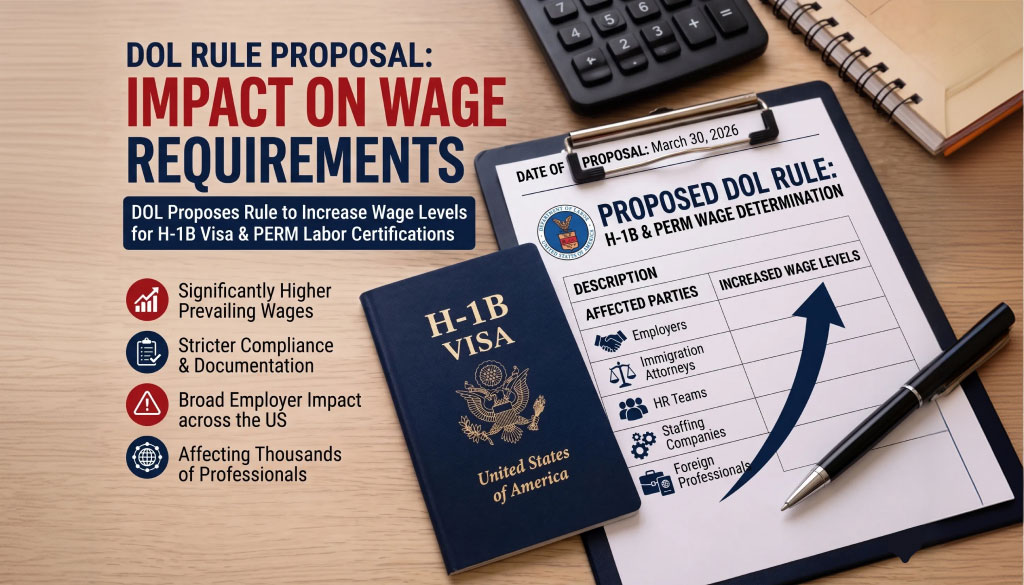
On March 30, 2026, the U.S. Department of Labor (DOL) proposed a new rule that could significantly increase prevailing wage requirements for H-1B visas and PERM labor certification filings. If finalized, the changes could affect thousands of employers, immigration attorneys, HR teams, staffing companies, and foreign professionals across the United States.
The proposal focuses on revising how prevailing wages are calculated under the Occupational Employment and Wage Statistics (OEWS) system used for H-1B, H-1B1, E-3 visas, and PERM labor certifications. According to the DOL, the goal is to better align foreign worker wages with wages paid to similarly employed U.S. workers in the same occupation and location.
For employers already dealing with increasing operational costs and strict immigration compliance requirements, this proposed rule could add another layer of financial and administrative pressure.
What Is Changing Under the Proposed Rule?
Under the current system, prevailing wages are divided into four wage levels based on percentile ranges. The proposed rule would significantly increase those percentile benchmarks across all wage levels.
For example, Level I wages, which are commonly used for entry-level roles, would increase from the 17th percentile to the 34th percentile. Similarly, Level IV wages would rise from the 67th percentile to the 88th percentile.
| Wage Level | Current Percentile | Proposed Percentile |
| Level I | 17th percentile | 34th percentile |
| Level II | 34th percentile | 52nd percentile |
| Level III | 50th percentile | 70th percentile |
| Level IV | 67th percentile | 88th percentile |
If implemented, these changes could significantly increase salary requirements across many occupations and geographic regions. Industry experts estimate that prevailing wages could rise by approximately 21% to 33%, depending on the role, location, and experience level.
For many employers, especially those hiring entry-level foreign professionals, the biggest concern is that Level I wages may begin resembling today’s Level II wage standards.
Why Is the DOL Increasing Wage Levels?
According to the Department of Labor, the proposed changes are intended to strengthen wage protections for U.S. workers and ensure foreign workers are compensated fairly.
The DOL believes that the current wage structure may, in some cases, allow employers to pay foreign professionals below market rates. By increasing prevailing wage levels, the agency aims to reduce wage undercutting concerns and improve the overall integrity of employment-based visa programs.
The proposal is also intended to discourage misuse of programs like H-1B and PERM while ensuring employers use these visa categories only when they genuinely need skilled foreign talent.
How Could This Affect H-1B Employers?
If the rule is finalized, H-1B employers could face significantly higher salary obligations and increased compliance scrutiny.
Many companies currently rely on Level I wage structures for entry-level or junior positions. Under the proposed framework, those wage levels may no longer be financially practical for some employers.
This could particularly affect
- IT consulting companies
- Staffing firms
- Startups
- Small and mid-sized businesses
- Employers with large H-1B workforces
In addition to higher labor costs, employers may also face increased scrutiny regarding wage level selection and job classification strategies.
USCIS and DOL officers may pay closer attention to whether
- Job duties match the wage level
- SOC codes accurately reflect the role
- Specialty occupation requirements are properly documented
- LCAs are supported by defensible evidence
Even minor inconsistencies between job duties, support letters, wage levels, and SOC code selections could potentially trigger RFEs or compliance concerns.
Immigration Attorneys May Face Greater Documentation Pressure
For immigration attorneys, the proposed wage increases could make petition preparation more complex and time-consuming.
As prevailing wages rise, attorneys may need to spend additional time reviewing SOC codes, wage levels, job descriptions, end-client documentation, and support letters to ensure everything aligns correctly.
This becomes especially important because SOC code selection directly impacts
- Prevailing wage determination
- Specialty occupation analysis
- LCA preparation
- Overall petition strength
A weak or mismatched SOC code could lead to wage inconsistencies, specialty occupation RFEs, or even petition denials.
Attorneys handling third-party placement cases may face even greater scrutiny, particularly when documenting supervision, control, and end-client job duties.
Impact on PERM Labor Certification Filings
The proposed changes could also significantly affect PERM labor certification cases for EB-2 and EB-3 green card sponsorships.
Because PERM cases are heavily tied to prevailing wage determinations, higher wage requirements could significantly increase sponsorship costs for employers.
Employers may need to
- Reevaluate offered salaries
- Increase recruitment budgets
- Recalculate sponsorship costs
- Review prevailing wage strategies
- Adjust long-term workforce planning
Small and mid-sized businesses could face additional challenges balancing higher wage requirements with operational budgets.
In competitive industries, employers may also struggle to maintain profitability while meeting revised prevailing wage standards.
Why SOC Codes & Wage Alignment Matter More Than Ever
SOC codes have always played a critical role in H-1B and PERM filings, but under the proposed wage framework, they may become even more important.
A poorly selected SOC code can create multiple risks, including:
- Wage mismatches
- Specialty occupation challenges
- LCA inconsistencies
- Increased FDNS scrutiny
- Higher RFE risks
As prevailing wage expectations increase, employers and attorneys may face greater pressure to justify job complexity, educational requirements, wage level selection, and actual day-to-day responsibilities.
This means consistency across petitions, support letters, LCAs, client documentation, and job descriptions will become increasingly important for maintaining strong and defensible filings.
What Employers & Attorneys Should Do Now
Although the rule has not been finalized yet, immigration attorneys and employers should begin preparing proactively rather than waiting for implementation.
This is a good time to review existing wage structures, audit SOC code usage, strengthen documentation practices, and identify potential compliance gaps.
Employers who heavily rely on Level I wages may also want to evaluate future hiring strategies and prepare for possible salary increases if the rule moves forward.
Similarly, immigration law firms may benefit from reviewing internal filing workflows to reduce inconsistencies and improve overall petition quality before compliance scrutiny increases further.
How Immigration Software Can Help
As H-1B and PERM filings become more complex, many law firms and employers are turning to automation to reduce risk and improve efficiency.
Immigration software platforms like Imagility help streamline the process by recommending relevant SOC codes, aligning job duties with wage levels, automating petition preparation, and maintaining consistency across filings.
Automation can also help firms reduce manual errors, improve audit readiness, and prepare petitions faster while minimizing risks related to wage selection and documentation inconsistencies.
For attorneys managing high petition volumes, this becomes increasingly valuable as compliance expectations continue to evolve.
Is the Rule Effective Right Now?
No. The proposed rule is not currently in effect.
Before implementation, the rule must go through the federal rulemaking and public comment process. The Department of Labor will review public feedback before deciding whether to finalize the changes.
Until then, the current prevailing wage framework remains in place.
Final Thoughts
The DOL’s proposed wage rule could become one of the most significant changes to employment-based immigration processing in recent years.
If finalized, employers may face higher prevailing wage obligations, increased compliance scrutiny, more complex filing strategies, and greater documentation requirements across H-1B and PERM cases.
For immigration attorneys and employers, this is the right time to proactively review wage strategies, SOC code selections, petition workflows, and compliance practices to prepare for potential changes ahead.