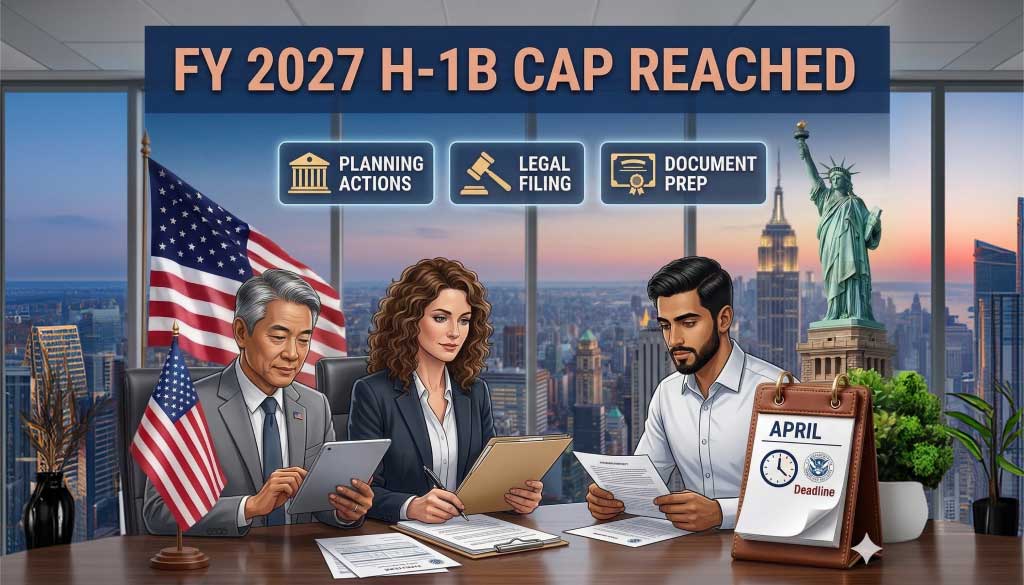
The U.S. Citizenship and Immigration Services (USCIS) has officially reached the FY 2027 H-1B cap, including the advanced degree exemption. With the lottery complete, selected registrants can now move to the next phase, filing H-1B cap-subject petitions.
But while selection is a milestone, it is not the finish line. In many ways, it’s where the real work begins.
From Lottery Selection to Petition Filing
Starting April 1, 2026, petitioners with selected beneficiaries can begin filing H-1B cap-subject petitions using the latest version of Form I-129 (02/27/26 edition).
To move forward successfully, petitioners must
- File within the designated filing window (minimum 90 days)
- Include a copy of the selection notice
- Ensure consistency between registration and petition details
- Submit all supporting documentation
Remember, selection only grants eligibility to file; it does not guarantee approval.
The Reality Behind H-1B Petition Filing
On paper, the process appears procedural. In practice, it is often complex and resource-intensive.
- Attorneys manage high volumes of cases under tight timelines
- Petitioners navigate compliance requirements and documentation pressure
- Beneficiaries often lack visibility into petition progress and outcomes
At the same time, USCIS expectations remain stringent, especially around role clarity and specialty occupation alignment, wage level justification, and employer-employee relationship documentation. Even minor inconsistencies can lead to delays, or requests for evidence (RFEs).
Where Challenges Typically Arise
Across organizations, common friction points include the following.
- Fragmented collaboration between legal teams, employers, and beneficiaries
- Manual data entry and repetitive documentation tasks
- Limited visibility into petition status
- Last-minute reviews increase the risk of errors
These gaps not only slow down the process but can also impact petition quality.
Why a Structured Approach Matters
A more structured, technology-backed approach can help shift petition filing from reactive to proactive. This includes guided workflows instead of ad hoc processes, centralized data instead of scattered inputs, built-in validation instead of manual checks, and continuous visibility instead of status uncertainty.
How Imagility Supports H-1B Petition Filing
Imagility is built to bring structure, collaboration, and intelligence into the H-1B petition lifecycle, supporting attorneys, petitioners, and beneficiaries at every stage.
- Petition Builder: Simplifying Form I-129
Instead of navigating Form I-129 manually, the platform
- Breaks the form into guided timeline-based steps
- Captures
- Employer information
- Position details
- Beneficiary data
This makes the process easier to follow and reduces manual errors.
2. Building Key Petition Elements
The platform goes beyond form-filling by helping structure critical components
- Job duties and responsibilities
- Beneficiary qualifications
- Project descriptions and timelines
- Employer-employee relationships (including third-party scenarios)
These elements are often central to petition strength and adjudication outcomes.
- Timelines and Workflow Management
To improve coordination and accountability
- Tasks are assigned with clear ownership
- Role-based permissions ensure controlled access
- Visual workflows provide real-time progress tracking
This creates transparency across all stakeholders.
- Notifications and Document Checklists
To keep the process on track
- Automated alerts for pending tasks
- Notifications for document expiration
- Petition-level updates (e.g., amendments, visa expiry)
- A centralized document checklist for tracking completeness
- Review and Petition Analysis
Before submission, the platform enables
- Compilation of the complete petition with supporting documents
- Automated checks to identify gaps or inconsistencies
- Intelligent recommendations to improve petition quality
This allows multiple iterations before final submission.
- Submission and Post-Filing Tracking
Once the petition is ready
- It can be prepared for submission to USCIS
- Receipt notices and updates can be tracked
- Post-filing steps, including visa stamping guidance, are supported
- Beyond Filing: End-to-End Lifecycle Support
The process doesn’t end with submission. The platform also supports
- Extensions
- Transfers
- Amendments
- Ongoing stakeholder engagement throughout the immigration journey
Final Thoughts
With the FY 2027 H-1B cap now reached, the focus shifts to execution, accuracy, and coordination. A strong petition requires clear documentation, consistency across all inputs, and timely collaboration between stakeholders. As the process grows more complex, structured and transparent workflows are becoming essential, not just for efficiency, but for better outcomes.
Request a demo to see how Imagility can help you with your H-1B petition.