

I-9 Remediation Services: Audit-Ready, Defensible, Attorney-Guided
Many organizations don’t realize they have I-9 compliance issues until years after hiring activity has scaled. By then, errors such as missing signatures, incomplete verification sections, outdated form versions, and inconsistent document records may exist across dozens or even hundreds of employees.
- Attorney-reviewed
- Audit-ready solutions
- Complete documentation

Can I-9 Forms Be Fixed Before an Audit?
Yes, but only if corrections follow strict regulatory guidelines. Improper fixes can increase risk rather than reduce it.
I-9 remediation is the structured process of reviewing, correcting, and documenting Form I-9 records so they meet employment eligibility verification requirements and can withstand regulatory scrutiny.
For most employers, the goal is not perfection. The goal is defensibility, ensuring that every correction is lawful, traceable, and audit-ready.
Defensibility, Not Perfection
What I-9 Remediation Actually Means
I-9 remediation is often mistaken for simply “fixing mistakes.” In reality, it is a systematic compliance exercise that evaluates your entire I-9 ecosystem
A well-executed remediation includes
- A full review of existing Form I-9 records
- Identification of missing or incomplete forms
- Corrections applied using DHS and ICE-compliant methods
- Documentation of every correction made
- Process improvements to prevent repeat errors
Remediation does NOT mean rewriting history
- Original entries must remain visible
- Corrections must be clearly annotated
- Dates and responsible parties must be documented
When handled correctly, remediation signals good-faith compliance, which can significantly influence how regulators assess your organization during an audit.
Why “Attorney-Guided”
Remediation Matters
Attorney-Guided Remediation ensures corrections align with DHS and ICE guidance and reduces the risk of non-comliant fixes.

Not all corrections are compliant corrections. Because I-9 errors can directly impact regulatory exposure, many organizations rely on attorney-guided remediation frameworks to ensure accuracy and defensibility.
In practice, this means
→ Correction methods align with DHS and ICE guidance
→ No improper practices like backdating or overwriting
→ Documentation supports audit defensibility
→ Risky correction shortcuts are avoided
This approach helps employers fix issues without creating new compliance problems, which is more common than many realize.
Common I-9 Compliance Issues Employers Discover
Most I-9 errors are not intentional. They result from routine administrative gaps that compound over time.
During remediation, organizations frequently uncover
Incomplete Section 1 entries
Missing employee details such as citizenship status or signatures
Late Section 2 completion
Verification not completed within the required three business days
Use of outdated Form I-9 versions
Continuing old forms after new versions are released
Incorrect document recording
Errors in List A, B, or C document details
Missed reverification deadlines
Failure to track expiring work authorization
Fragmented recordkeeping
I-9s stored across paper files, emails, and HR systems
Individually, these may seem minor. Collectively, they can create significant compliance exposure.
Not all I-9 errors can be corrected retroactively. Understanding the difference is critical to avoiding non-compliant fixes.
Fixable and Non-Fixable I-9 Errors
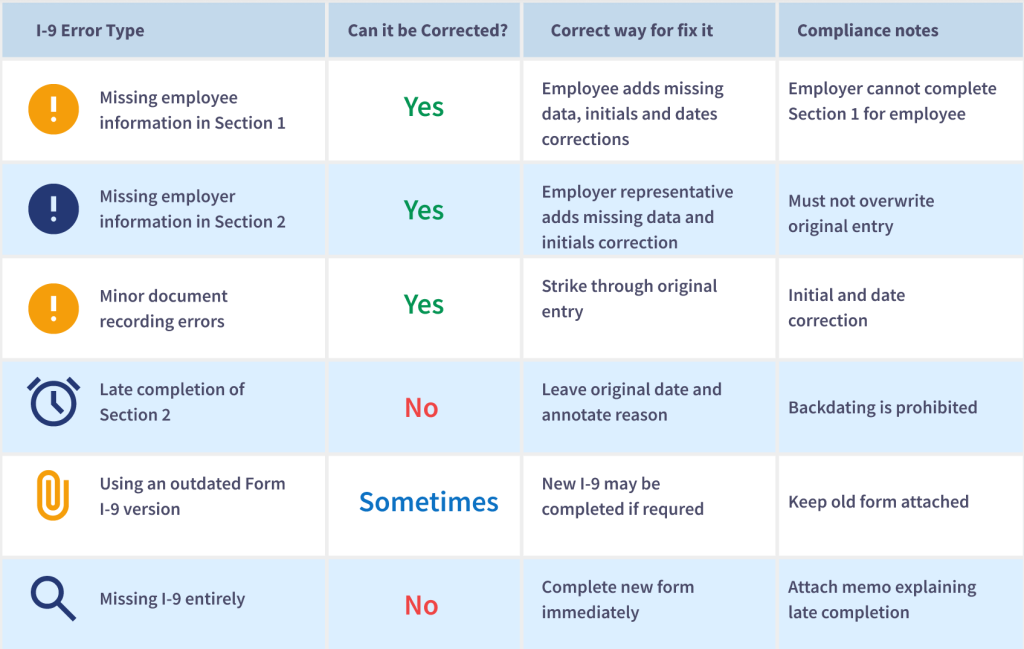
Our Structured I-9 Remediation Methodology
Effective remediation follows a clear, repeatable framework. Without structure, consistency and defensibility are difficult to achieve.
Initial Risk Assessment
Start by understanding the scope
• Total number of I-9 records
• Missing or incomplete forms
• Overall compliance risk level
Comprehensive I-9 Review
Each form is evaluated for:
• Missing employee or employer information
• Incorrect document details
• Expired work authorization without reverification
• Use of outdated forms
Correction Planning
Before making changes, a structured plan ensures:
• Original data is preserved
• Approved correction methods are followed
• A clear audit trail is maintained
Controlled Remediation Execution
Corrections are applied consistently using defined
workflows:
• Standardized correction formats
• Clear annotation practices
• Role-based accountability
Compliance Reporting
Post-remediation, organizations gain visibility into:
• Errors identified
• Corrections applied
• Remaining risk areas
• Recommended improvements
Ongoing Compliance Controls
To prevent repeat issues, organizations implement:
• Reverification tracking
• Centralized document storage
• Compliance dashboards
• Structured onboarding workflows
Before vs After Remediation
Before Remediation
I-9s stored across paper files, emails, and spreadsheets
Missing or incomplete employee information
No visibility into reverification deadlines
Inconsistent correction practices
Difficult document retrieval during audits
After Structured Remediation
Centralized I-9 record management
Corrected entries with clear annotations
Automated reverification alerts
Standardized correction methodology
Audit-ready records with full audit trail
Quick I-9 Audit Readiness Checklist
Use this checklist to evaluate whether your organization is prepared for a potential inspection.
- All employees hired after November 6, 1986 have a completed Form I-9
- Forms are stored in a centralized and secure location
- Section 2 is completed within three business days of hire
- Expiring work authorization is tracked and reverified
- Corrections follow DHS-approved annotation methods
- Outdated form versions are no longer used
- I-9 records can be produced within three business days of request
- Corrections include initials, dates, and explanations where required
If several items on this list are unclear or incomplete, remediation may be necessary to reduce compliance risk.
The Role of Technology in I-9 Remediation
At scale, manual remediation becomes inefficient and error-prone. Technology introduces consistency, auditability, and control.
Key capabilities include
→ Centralized I-9 storage
→ Automated error detection
→ Correction tracking and audit logs
→ Reverification alerts
→ Audit-ready reporting
Manual Vs Platform-Driven Remediation
Manual Remediation
Platforms like Imagility support remediation through workflow-driven correction processes, helping organizations maintain both compliance and documentation integrity.
I-9 Remediation Workflow
Centralized
Records
Automated Error Detection
Guided
Corrections
Audit Trail
Tracking
Status Update & Notifications
Key Takeaways
FAQs: I-9 Remediation
What is I-9 remediation?
It is the process of reviewing, correcting, and documenting Form I-9 records to ensure compliance and audit readiness.
Can old I-9 forms be corrected?
Yes, as long as corrections follow proper guidelines and preserve original information.
Why do companies conduct I-9 remediation?
To identify risks, fix errors, and prepare for potential ICE inspections.
Does remediation eliminate compliance risk?
No, but it significantly reduces risk and helps demonstrate good-faith compliance.
Take the Free Five-Minute I-9 Risk
Diagnostic
If your organization manages a growing workforce, proactive I-9 review is essential. Identify
compliance gaps before they turn into audit risks.
- Understand your I-9 exposure
- Get expert-backed insights
- Move toward audit readiness