

SOC Code Risk Calculator for
H-1B & Employment-Based Filings (2026 Edition)
Avoid RFEs, denials, and compliance risks — audit your SOC code selection in minutes.
A weak SOC strategy can lead to months of delays, expensive corrections, project onboarding issues, and preventable RFEs. H-1B petitions with weak role-to-SOC alignment are significantly more likely to receive specialty occupation RFEs or wage-related scrutiny.
Most attorneys don’t realize the risk until
- The wage level doesn't align
- The job duties look generic
- Or worse, USCIS questions the specialty occupation
This interactive SOC risk calculator helps you identify issues
and get an instant risk score before filing.
- RFE Risk Check
- Wage Alignment
- LCA Consistency
- Audit Readiness


What You'll Get

A 2-minute SOC risk assessment checklist

Instant visibility into hidden RFE triggers

Wage level & specialty occupation risk indicators

Common filing inconsistencies attorneys often miss

A practical framework to strengthen H-1B and PERM filings before submission
SOC Risk Assessment Checklist for Immigration Attorneys
Takes less than 2 minutes. Answer the following to calculate your SOC risk score.
Progress
0 / 19 answered
Your SOC Risk Score
YES = 1 point
NO = 0 points
0/20
High Risk
High risk detected. Your SOC selection may lead to RFEs, compliance issues, or denial.
Higher scores indicate stronger petition defensibility and lower RFE exposure.
AI Insight
Your risk level updates automatically based on your responses.
Risk Interpretation

16–20 Points
Your SOC selection is strong and defensible.
Your filing looks strong. Still, a final validation can help ensure audit readiness.

16–20 Points
Some inconsistencies — may trigger RFEs.
Your filing looks strong. Still, a final validation can help ensure audit readiness.

Below 10 Points
Your filing may be vulnerable to:
- Specialty occupation RFEs
- Wage level scrutiny
- Delayed onboarding
- Costly refiling or amendments
- Petition denial
- Increased future compliance scrutiny
High risk detected. Your SOC selection may lead to RFEs, compliance issues, or denial.
How to Reduce SOC Risk
Manually reviewing SOC codes across petitions, LCAs, and job duties is
time-consuming — and errors are easy to miss.
Platforms like Imagility help by
- Recommending relevant SOC codes
- Aligning job duties with roles
- Ensuring consistency across filings
- Reducing manual errors
- Detect filing inconsistencies earlier
Attorneys often discover SOC issues only after receiving an RFE, when fixing the problem becomes significantly more time-consuming and expensive.

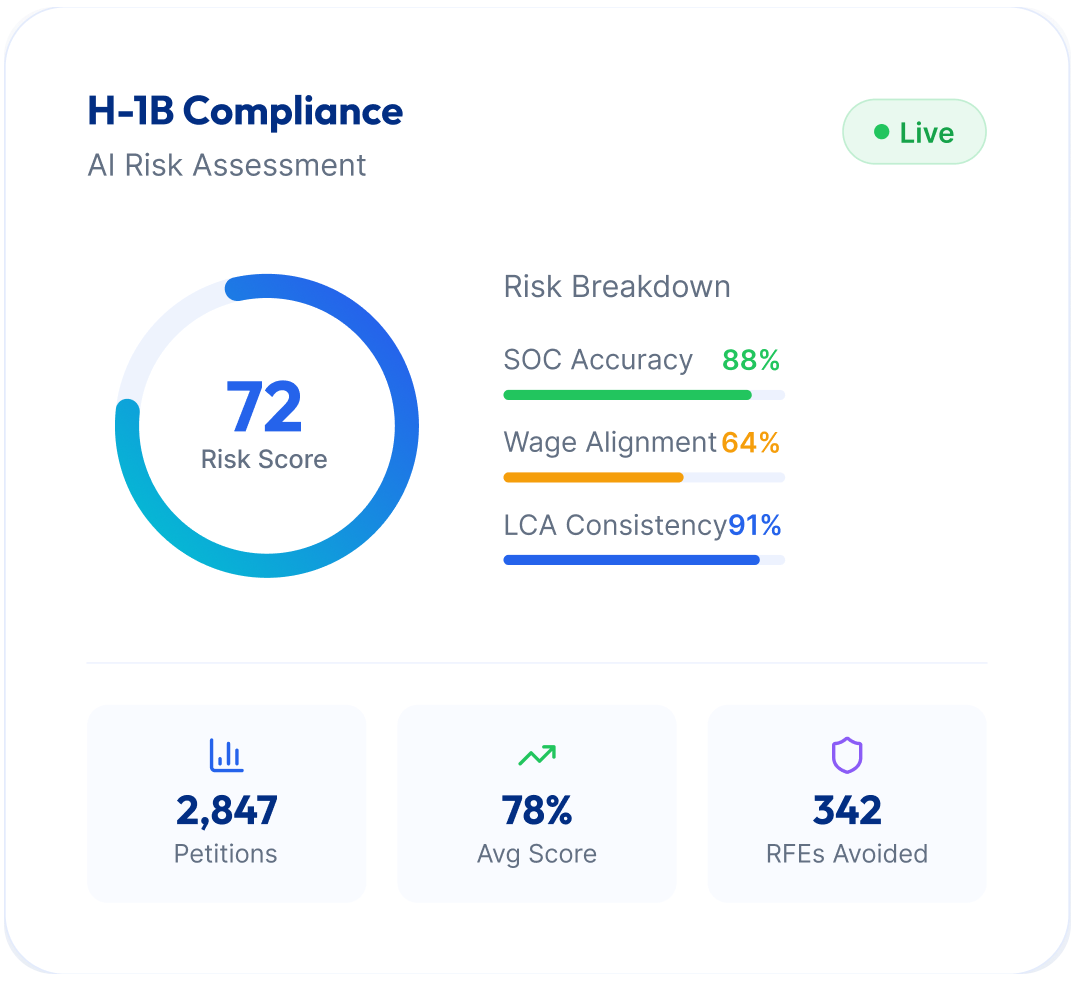
Imagility SOC Analyzer
● Live Assessment
SOC Codes
94%
Wage Levels
87%
Job Duties
91%
LCA Consistency
94%
Your filing looks strong. Still, a final validation can help ensure audit readiness.
FAQs
What is an SOC code in H-1B?
SOC code is a classification used to define job roles for wage determination and compliance.
Why is the SOC code important in immigration filings?
It impacts wage levels, eligibility, and RFE risk.
Can a wrong SOC code cause denial?
Yes, incorrect SOC codes can lead to RFEs or denials.
How do I choose the correct SOC code for H-1B?
The SOC code should align with job duties, required qualifications, and wage level. Misalignment can lead to RFEs or denial.
Reduce SOC Code Risk Before Filing
Use Imagility to improve SOC code accuracy, align job duties, reduce
inconsistencies, and strengthen petition readiness.
10,000+
H-1B Petitions Processed
94%
RFE Reduction Rate
2 min
Average Risk Assessment
SOC 2
Security Certified