

How to Prepare an L‑1 Petition Using
AI Workflows

This e-guide explains, step by step, how attorneys can prepare an L‑1 visa petition using AI-assisted workflows, improving quality and reducing avoidable mistakes.
- Attorney-reviewed
- Free to download
- AI-powered workflow
8 Step Workflow 30% Fewer Errors 5 FAQ Answered
What is an L‑1 Petition?
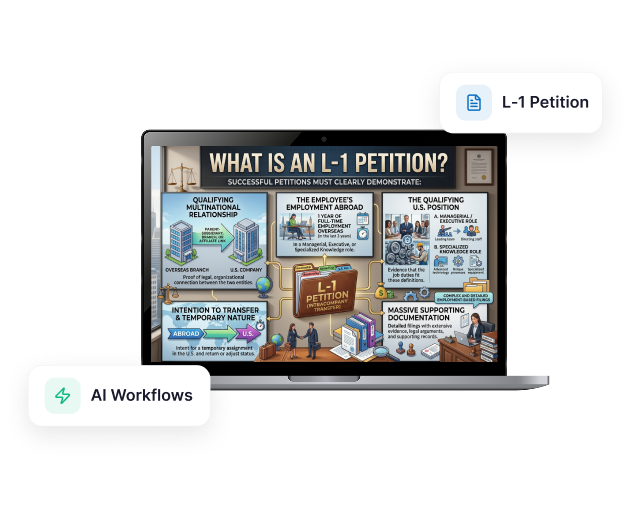
L‑1 petitions are among the most detailed and complex employment-based filings immigration attorneys prepare. Successful petitions must clearly demonstrate:
- A qualifying relationship between the U.S. company and a foreign entity
- The beneficiary's one-year qualifying employment abroad
- The U.S. position as executive, managerial, or specialized knowledge
- Consistent documentation across forms and supporting evidence
Traditionally, preparing an L‑1 petition involves hours of manual data entry, document review, cross-checking, and proofreading. Even experienced attorneys may encounter inconsistencies, missing evidence, or gaps in the timeline that lead to Requests for Evidence (RFEs) or delays.
Artificial intelligence (AI) is changing how attorneys manage this work. AI workflows can help attorneys prepare petitions more efficiently, catch common errors, and ensure clearer alignment between facts and legal requirements.
This e-guide explains, step by step, how attorneys can prepare an L-1 visa petition using AI-assisted workflows, improving quality and reducing avoidable mistakes.
Why AI Matters in L‑1 Petition Preparation
Before we walk through the steps, it’s important to understand why AI is useful in this context.
AI doesn’t replace legal judgment or strategy. Instead, it supports attorneys by:
- Looking for inconsistencies across multiple documents
- Checking completeness of required evidence
- Validating timelines and status history
- Extracting key data from uploaded files
- Highlighting potential weaknesses before filing
In document-heavy filings like L‑1 petitions, these capabilities save time and reduce costly oversights.
Research in legal technology shows that combining human review with automated checks can reduce avoidable errors by up to 30%, especially in complex multi-document cases. That matters in immigration, where quality and completeness directly influence adjudicator decisions.
AI helps attorneys prepare better petitions — not only faster, but with stronger accuracy and confidence.
Step-by-Step AI Workflow
Follow this proven 8-step framework for preparing an L‑1 petition using
AI-assisted workflows.
1 Step 1
Structured Intake and Case Setup
The first step in any immigration filing is accurate client and case intake.
Traditional Challenge
Attorneys gather information through emails, forms, and interviews. Details often land in different places, creating fragmented data.
AI-Assisted Approach
AI workflows start with a structured intake form that collects case information, such as:
- Employer details
- Foreign entity information
- Beneficiary background
- Job title, duties, and location
- Dates of employment
- Wage details
The intake system validates required fields and reminds users when critical information is missing. Structured data capture ensures that later steps rely on consistent information from the start.
Benefits
- Reduced data duplication
- Easier review and updates
- Faster movement in evidence collection
2 Step 2
Document Upload and Automated Classification
L‑1 petitions require a wide array of documents:
- Corporate relationship proofs
- Organizational charts
- Employment verification letters
- Pay records
- Passport and visa pages
- Support evidence for specialized knowledge or managerial duties
The intake system validates required fields and reminds users when critical information is missing. Structured data capture ensures that later steps rely on consistent information from the start.
Traditional Challenge
Documents arrive in various formats and folder locations. Attorneys spend hours labeling and organizing them.
AI-Assisted Approach
AI workflows allow users to upload documents in bulk. The system then:
- Recognizes document type (e.g., passport, org chart, employment letter)
- Extracts key information such as names, dates, and titles
- Classifies and tags each document for easy retrieval
This automated classification helps attorneys avoid manual sorting and ensures that every document is linked to the correct part of the petition.
Benefits
- Faster document organization
- Automatic capture of key dates and facts
- Reduced risk of losing critical evidence
3 Step 3
Eligibility and Role Analysis
Once the data and documents are in place, the next step is assessing eligibility.
For L‑1 petitions, eligibility is based on:
- Qualifying corporate relationship
- One year of employment abroad in the relevant role
- A qualifying role in the U.S. office
Traditional Challenge
Assessing eligibility involves manual review of job duties, titles, dates, and reporting relationships across multiple files.
AI-Assisted Approach
AI reviews job descriptions, organizational charts, and role duties to identify:
- Whether the position meets managerial/executive duties
- Whether the position qualifies as specialized knowledge
- Whether the employment abroad meets the one-year requirement
The AI highlights areas where explanations may be weak or unclear and suggests where additional evidence or language may be needed.
Benefits
- Early warning about eligibility weaknesses
- More consistent narrative preparation
- Reduced risk of eligibility-related RFEs
4 Step 4
Cross-Document Consistency Checks
In L‑1 petitions, consistency is critical. The same details should match across forms, letters, and evidence.
Traditional Challenge
In L‑1 petitions, consistency is critical. The same details should match across forms, letters, and evidence.
AI-Assisted Approach
AI compares structured data across the petition package, including:
- Employer and entity names
- Dates of employment
- Job titles and duties
- Worksite locations
- Reporting relationships
Any conflicting values are flagged for review — for example, if the beneficiary’s job title differs between the support letter and the I-129 form or if employment dates do not align across letters and pay records.
Benefits
- Detects mismatches before submission
- Prevents common consistency-related RFEs
- Improves the credibility of the case record
5 Step 5
Timeline Verification
Immigration filings depend heavily on accurate timelines — especially for the one-year employment requirement for L‑1 petitions.
Traditional Challenge
Collecting and aligning multiple date fields (employment periods, status history, pay records, contracts) manually often leads to gaps or overlaps.
AI-Assisted Approach
AI reconstructs the beneficiary’s employment timeline from all relevant documents and highlights:
- Gaps in employment
- Overlapping or conflicting dates
- Missing pieces in status history
This timeline view makes it easier for attorneys to verify the qualifying period and ensure all evidence supports it.
Benefits
- More accurate timeline analysis
- Reduced status-related RFEs
- Clear basis for eligibility argument
6 Step 6
Evidence Completeness Review
Before filing, attorneys must confirm that everything required for an L‑1 petition is present and clearly explained.
Traditional Challenge
Manual checklist reviews often miss required documents, leading to last-minute collections or incomplete filings.
AI-Assisted Approach
AI compares the petition against expected evidence categories for L‑1 visas and flags any missing or weak items, such as:
- Corporate relationship proof
- Organizational charts for both U.S. and foreign entities
- Proof of qualifying employment abroad
- Evidence supporting managerial or specialized duties
- Support letters and service contracts
This is not a legal judgment but a completeness check so attorneys can confirm before submission that no categories are missing.
Benefits
- Higher first-pass completeness
- Fewer evidence-based RFEs
- More efficient review cycles
7 Step 7
Final Quality Review
Even with automation, attorney review remains essential.
AI-Assisted Approach
AI provides:
- A summary of flagged issues
- A checklist of missing or inconsistent items
- A timeline view
- A consistency report
Attorneys use this output to perform final verification, refine legal arguments, and confirm submission readiness. This creates a structured and transparent quality-assurance step before filing.
Benefits
- Higher confidence in the final petition
- Reduced risk of avoidable RFEs
- Clear audit trail of review
8 Step 8
Petition Submission and Tracking
Once the petition is ready, automation streamlines submission.
AI-Assisted Approach
AI workflows support:
- Electronic form submission
- Electronic form submission
- Tracking of receipts and notices
- Centralized view of case status
This eliminates manual entry into government portals, reduces duplicate work, and gives attorneys real-time visibility into adjudication progress.
Benefits
- Faster submission
- Better status visibility
- Organized case tracking
Final Takeaways
L‑1 petitions are complex, document-driven filings where quality and consistency matter. Manual methods work, but they are slow and prone to avoidable errors. AI‑assisted workflows do not replace the attorney’s legal judgment or strategy. Instead, they enhance review, improve data quality, and help attorneys prepare stronger petitions with less administrative burden.
By using AI for structured intake, evidence review, consistency validation, and form assembly, attorneys can build more accurate L‑1 petitions and reduce the risk of RFEs. Importantly, the attorney remains in control at every step, armed with better information, fewer oversights, and higher confidence before submission.
Frequently Asked Questions
What is required for an L‑1 petition?
An L‑1 petition must demonstrate:
- A qualifying relationship between the U.S. company and a foreign entity
- At least one year of qualifying employment abroad within the last three years
- A U.S. role that requires executive, managerial, or specialized knowledge
- Consistent and well-documented supporting evidence
Clear documentation and alignment across forms and support letters are critical for approval.
What documents are needed for an L‑1 visa petition?
Common L‑1 petition documents include:
- Proof of corporate relationship between U.S. and foreign entities
- Organizational charts (U.S. and foreign)
- Employment verification letters
- Pay records and tax documents
- Detailed job descriptions
- Passport and prior immigration records
- Form I-129 and L Supplement
The strength of documentation often determines whether the case is approved or receives an RFE.
What are common reasons for L-1 RFEs?
Common RFE triggers include:
- Weak explanation of managerial or executive duties
- Insufficient proof of specialized knowledge
- Inconsistent employment dates
- Missing corporate relationship evidence
- Conflicting job titles across documents
Most RFEs result from documentation gaps or inconsistencies rather than ineligibility.
How can AI help reduce RFEs in L-1 petitions?
AI reduces RFEs by:
- Detecting inconsistencies across forms and support letters
- Verifying employment timelines
- Identifying missing evidence categories
- Flagging unclear job duty descriptions
- Running structured completeness checks before submission
This allows attorneys to correct issues before filing.
Can AI determine if an L-1 role qualifies as managerial or specialized knowledge?
AI can assist by reviewing job descriptions, organizational structures, and reporting lines to highlight whether duties align with managerial, executive, or specialized knowledge standards.
However, final eligibility determination and legal analysis always remain the attorney’s responsibility.